

Cloud architecture
Workload design on managed services, with landing zone, networking and identity fitted to your tenancy.
HomeCapabilitiesServicesCloud-Native Engineering
Digital Engineering
Moving a server image to cloud changes where the invoice comes from, not how the application behaves. Elasticity, resilience and cost control only arrive when the application is engineered for them.
We design and build cloud-native workloads — containers, managed services, event-driven components — with the operational concerns handled in the platform rather than in a runbook.
Cost is a design decision here. Right-sized services, autoscaling policies and storage tiers are chosen with the finance number in view, because a cloud bill nobody can explain is the most common reason a migration is judged a failure.
The same applies to resilience: health checks, retries, graceful degradation and a tested recovery path, so an availability zone problem is an alert rather than an outage report.
Talk to Us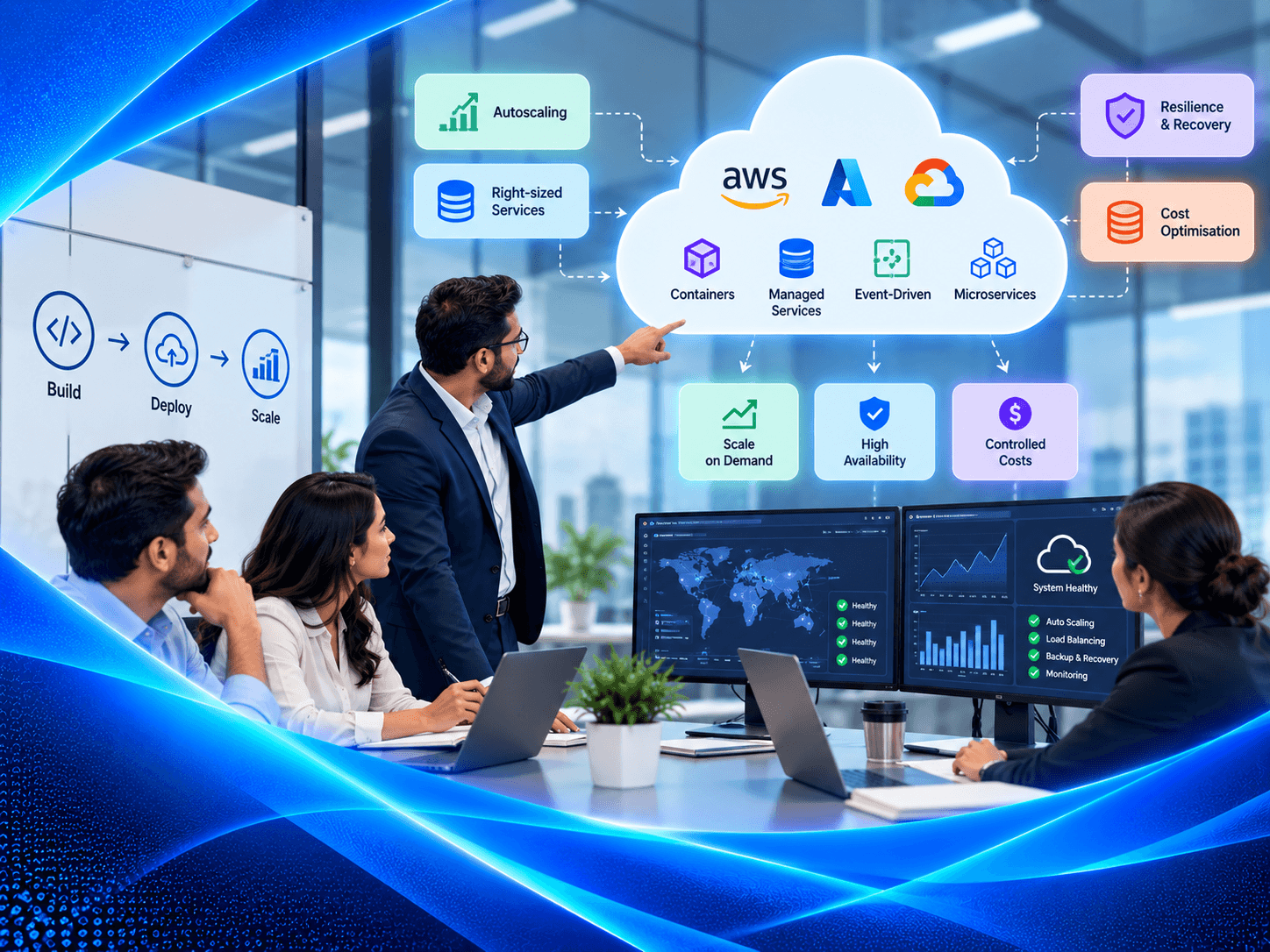
Solution
Architecture and build on Azure or OCI using managed services first, so less of the estate is a server your team has to patch.
Containerised workloads with autoscaling, infrastructure as code and environment parity from development through production.
Observability and cost telemetry built in from the start — logs, traces, dashboards and budget alerts against the workload, not the whole subscription.
Modules
What We Deliver
Workload design on managed services, with landing zone, networking and identity fitted to your tenancy.
Container build and orchestration, infrastructure as code and repeatable environment provisioning.
Health checks, autoscaling, failover design and recovery paths that are tested rather than documented.
Logs, traces, dashboards and cost telemetry per workload so spend and behaviour are both visible.
Outcomes
We measure success by the impact we create. Here's what good looks like when Cloud-Native Engineering is running the way it should.
Request a ConsultationAutoscaling policies size the workload against real load, so quiet hours stop being paid for at peak rates.
Infrastructure as code makes a new environment a pipeline run rather than a week of manual configuration.
Failover and restore are exercised in advance, so the recovery objective is a measurement rather than a claim.
Tagging and cost telemetry tie the bill to the service that generated it, which is where an optimisation starts.
Related
Let's talk
Tell us what you are trying to achieve. We will bring together the right capability, technology and delivery model to help move it forward.